The eventual fall of the Islamic Republic at the hands of the Iranian people, with support from the United States and Israel, would not mark the end of the threats facing either Iran or Israel. On the contrary, it could usher in a new and more complex phase of geopolitical challenges for both countries.
A post-Islamic Republic Iran would immediately confront formidable internal challenges: safeguarding national security, preserving territorial integrity, restoring public institutions, and rebuilding critical infrastructure. Decades of mismanagement, corruption, and repression have severely damaged the country’s water systems, food supply chains, healthcare networks, energy infrastructure, and industrial base. Rebuilding these sectors would require not only national cohesion and competent governance, but also strategic international partnerships. Israel, with its expertise in water management, agriculture, medicine, technology, energy, and infrastructure, could become an important partner in that process.
At the same time, Israel would face a dramatically changing regional environment. One potential development is the expansion of Turkey’s influence among Palestinian factions and Islamist movements, potentially filling some of the space previously occupied by Iran. Unlike the Islamic Republic, Turkey possesses a powerful military, is a NATO member, and enjoys considerable influence and legitimacy in much of the Muslim world. A more assertive Turkey could therefore present Israel with a different and potentially more sophisticated strategic challenge.
One indication of Turkey’s increasingly confrontational posture toward Israel is the Erdoğan government’s relationship with organizations and political movements associated with the Muslim Brotherhood. Saudi Arabia and Egypt have designated the Muslim Brotherhood as a terrorist organization, while other governments have adopted different classifications and policies toward the movement. Turkey, under President Recep Tayyip Erdoğan, has provided a relatively permissive political environment for Brotherhood-linked figures and organizations.
Following the September 11, 2001, terrorist attacks, Western governments, particularly the United States, placed greater emphasis on engagement with what was often described as “moderate Islam.” Turkey’s Justice and Development Party (AKP), under Erdoğan, benefited from this changing international environment[1] and won a landmark electoral victory in November 2002. Over the years, Erdoğan has increasingly presented Turkey as a defender of the Palestinians and as a leading voice in the Muslim world, while portraying Israel as a destabilizing force in the region.
There are multiple dimensions to Erdoğan’s increasingly hostile rhetoric toward Israel. Domestic political considerations have played a role, but opposition to Israel has also become an enduring component of Erdoğan’s political identity and of his vision for Turkey’s regional role.
The deterioration in Turkey-Israel relations has been particularly evident in recent years. On July 28, 2024, speaking to supporters of his AKP in Rize, Erdoğan said, “Just as we entered Karabakh, just as we entered Libya, we can do the same to them[2],” referring to the possibility of intervening against Israel. The statement represented one of his most explicit threats of military intervention against Israel.
Turkey’s relationship with the Muslim Brotherhood also deepened following the 2013 removal of Egyptian President Mohamed Morsi from power. Hundreds of Egyptian Muslim Brotherhood members subsequently relocated to Turkey, where the Erdoğan government provided political protection and a permissive environment for media activity, political organizing, and the reconstruction of Brotherhood-linked networks[3].
The relationship has continued to manifest itself through high-level contacts. During Turkey’s May 2023 presidential election, the International Union of Muslim Scholars (IUMS), an organization widely described as aligned with the Muslim Brotherhood, publicly supported Erdoğan’s candidacy. The organization issued a statement signed by 55 scholars from across the Islamic world calling on Muslims to support Erdoğan and framing the election as an Islamic duty[4].
On September 10, 2023, Erdoğan received a delegation at the presidential palace in Ankara led by Oussama Jammal, secretary-general of the U.S. Council of Muslim Organizations (USCMO), an umbrella organization whose constituent groups include individuals and organizations associated with the Muslim Brotherhood[5].
More recently, from August 23–29, 2025, the Turkish government hosted the International Union of Muslim Scholars at the Hayreddin Pasha Mansion in Istanbul. The delegation participated in a conference on Gaza co-organized with the state-supported Foundation of Islamic Scholars in Turkey. The conference reportedly brought together approximately 150 Islamic scholars from 50 countries, further illustrating Ankara’s role as a gathering place for religious and political figures aligned with Erdoğan’s vision of Turkey’s role in the Muslim world[6].
Taken together, these developments suggest that Erdoğan seeks to position Turkey as a principal political and ideological center of the Sunni Muslim world, while using opposition to Israel as an important component of that strategy. Whether Turkey ultimately becomes the principal regional counterweight to Israel remains uncertain, but the possibility deserves serious consideration.
The Risk of a Regional Vacuum
The Middle East is undergoing a profound political and ideological transformation. If Iran’s Islamic Republic were to collapse without a stable democratic successor, the resulting vacuum could create opportunities for other radical movements and regional powers to expand their influence.
A post-Islamic Republic Iran could face severe challenges from political fragmentation, economic dislocation, ethnic and regional tensions, armed separatist organizations, and competing foreign interests. A prolonged period of instability would not serve the interests of either the Iranian or Israeli people. It could instead create opportunities for Sunni Islamist movements to expand their influence while strengthening Turkey’s position as a regional power.
Egypt represents another critical variable. The country’s political stability and the future role of the Muslim Brotherhood could have profound consequences for the regional balance of power. A significant shift in Egypt’s political order—particularly one that weakened the secular institutions of the state or placed the military under the influence of Islamist forces—would fundamentally alter the strategic environment facing Israel and the broader Middle East.
The central question, therefore, is not simply what happens when the Islamic Republic ends. It is what comes next.
Why Iran Matters to Israel—and Israel Matters to Iran
The collapse of the Islamic Republic could create an historic opportunity to establish a secular, democratic, peaceful, and prosperous Iranian state. But such an outcome cannot be taken for granted. The transition could instead be marked by fragmentation, economic collapse, political extremism, or prolonged conflict.
For Israel, the emergence of a stable and democratic Iran would represent a fundamentally different regional reality from the one created by the Islamic Republic. For Iranians, normalization with Israel could open the door to technological cooperation, scientific exchange, trade, investment, and access to expertise that could accelerate national reconstruction.
This is why the relationship between a future free Iran and Israel should not be understood merely through the lens of current governments. The Iranian and Israeli peoples have interests that can extend beyond the policies of the regimes that currently rule them.
There is enormous potential for cooperation in areas such as water technology, agriculture, medicine, biotechnology, renewable energy, cybersecurity, environmental restoration, and scientific research. Israel has developed globally recognized expertise in many of these fields, while Iran possesses an enormous pool of scientists, engineers, physicians, entrepreneurs, and researchers whose talents have been constrained by decades of isolation.
The foundation for cooperation can therefore be built before political change occurs.
Building the Network Before the Transition
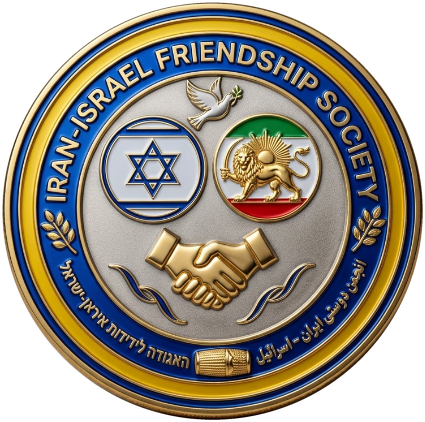
To help prepare for this future, the Iran-Israel Friendship Society has been established with the goal of strengthening people-to-people ties between Iranians and Israelis and laying the groundwork for enduring peace.
The organization’s founding members are initially drawn from scientists, physicians, engineers, industrial experts, researchers, academics, and other professionals. Its broader objective is to build an international network of individuals who believe that the interests of ordinary Iranians and Israelis are not inherently opposed and who are prepared to work together for a different future.
This network can encourage scientific exchange, cultural engagement, professional relationships, trade, and humanitarian cooperation. More importantly, it can create relationships and institutional connections that are ready to expand when political conditions permit.
If the Islamic Republic eventually falls, such networks could become an important resource in Iran’s reconstruction. International partnerships could help mobilize expertise, investment, technology, and institutional knowledge at a moment when they are urgently needed.
A successful democratic transition in Iran could also have consequences beyond Iran’s borders. A stable, secular, and prosperous Iran could become a counterweight to religious extremism and demonstrate that political Islam is not the only possible model for governance in the Muslim world.
A Shared Interest in a Different Future
The stakes are extraordinarily high.
For Iranians, the success or failure of a democratic transition could determine whether the end of the Islamic Republic leads to freedom and prosperity or to fragmentation and renewed authoritarianism.
For Israelis, the emergence of a stable and peaceful Iran could transform the strategic environment of the Middle East. Conversely, a failed transition could create new instability and opportunities for extremist movements and competing regional powers.
The interests of Iranians and Israelis therefore intersect in an important way: both peoples have an interest in seeing Iran emerge from the Islamic Republic as a stable, democratic, secular, and prosperous country.
People-to-people relationships can help lay the foundation for that future. Scientists can collaborate. Physicians can exchange knowledge. Entrepreneurs can build partnerships. Academics can establish networks. Artists and cultural institutions can reconnect two societies whose relationship has been severed by decades of political hostility.
But civil society alone cannot determine the outcome. Israeli policymakers also have an important role to play. Policies that encourage engagement with the Iranian people, support democratic and secular forces, and prepare for constructive relations with a future Iranian government could help create the conditions for a fundamentally different relationship between the two nations.
A free Iran and a secure Israel do not have to be competing visions.
They can be mutually reinforcing ones.
The time to begin building that future is before the transition—not after it.
- [1] Hudson Institute, September 3rd, 2015, The Naqshbandi-Khalidi Order and Political Islam in Turkey
- [2] The Begin-Sadat Center for Strategic Studies, June 21, 2026: From Karagöz and Hacivat to Israel: Erdoğan's Political Theater
- [3] British Journal of Middle Eastern Studies (2018), Shaimaa Magued, The Egyptian Muslim Brotherhood’s transnational advocacy in Turkey
- [4] Nordic Monitor, May 12, 2023, Qatari-backed Muslim scholars worldwide call for votes for Erdogan, claiming opposition is supported by enemies
- [5] Anadolu Agency, 07 September 2023, Yıldız Nevin Gündogmus, Turkish president receives members of US Muslim council in Ankara
- [6] Anadolu Agency, 23 August 2025, Gizem Nisa Demir, Scholars at Gaza conference in Istanbul stress urgent aid obligation